Modernization
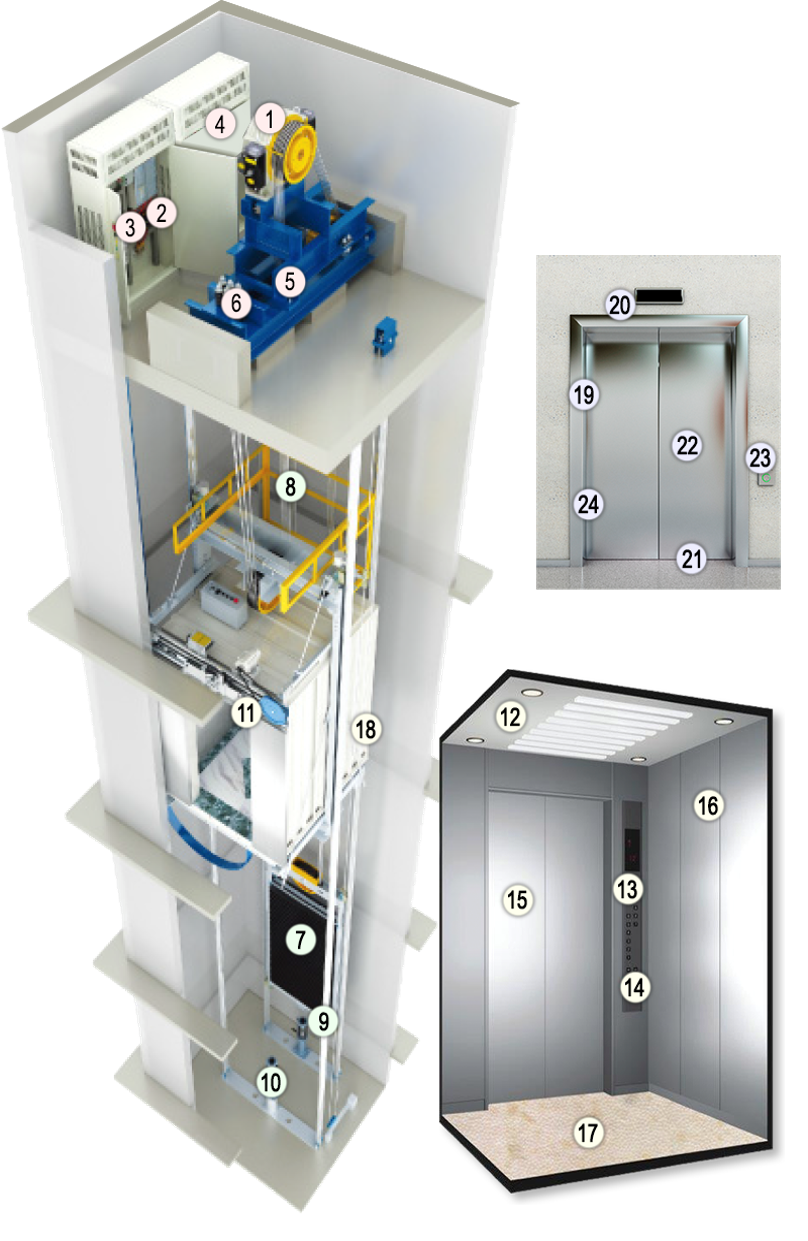
Modernization is a process in which certain reusable components of an existing aging elevator are retained,
while the remaining parts are replaced with new ones.
| Category | No | Component | Remarks |
|---|---|---|---|
| Machine Room | 1 | Traction Machine (Motor) | Replacement |
| 2 | Emergency Landing Device | New / Replacement | |
| 3 | Control Panel | Replacement | |
| 4 | Automatic Rescue Device | Replacement | |
| 5 | Machine Bed | Reuse | |
| 6 | Governor | Replacement | |
| Hoistway | 7 | Counterweight | Reuse |
| 8 | Main Rope | Replacement | |
| 9 | Guide Rail | Reuse | |
| 10 | Buffer | Replacement | |
| Car Interior | 11 | Door Controller | Replacement |
| 12 | Ceiling | Replacement | |
| 13 | Floor Indicator Panel | Replacement | |
| 14 | Interphone | Replacement | |
| 15 | Car Door | Replacement | |
| 16 | Car Wall Panels | Replacement | |
| 17 | Car Flooring | Replacement | |
| 18 | Car Frame | Replacement | |
| Landing Area | 19 | Door Frame | Replacement |
| 20 | Hall Door Operator | Replacement | |
| 21 | Hall Sill | Replacement | |
| 22 | Hall Door | Replacement | |
| 23 | Call Button | Replacement | |
| 24 | Door Safety Edge | New / Replacement |
This refers to the replacement of certain components to add the seven essential safety features required by elevator safety regulations for aging elevators.
| Category | Details |
|---|---|
|
Enforcement Rule Article 54 (Inspection Cycle for Periodic Inspections) |
1. Elevators that experienced a serious accident or major malfunction due to a defect as defined in Article 32(1)3(b) of the Act within the past two years: 6 months |
| 2. Elevators that have been in service for 25 years or more since the date of the installation inspection: 6 months | |
|
3. Freight elevators, car elevators, dumbwaiters, and elevators installed in single-family houses*:
2 years * Elevators installed in single-family houses as defined in subparagraph 1(a) of Attached Table 1 of the Enforcement Decree of the Building Act. |
※ For cases 1 and 2, elevators classified under item 3 (with a 2-year inspection cycle) are also subject to this rule.
Additionally, for case 1, the inspection cycle is adjusted to 6 months after undergoing a precise safety inspection.
| Type of Elevator | Additional Components or Safety Devices Required |
|---|---|
| Electric Elevators | 1) Landing door child finger-protection device, 2) Landing door assembly (anti-detachment device), 3) Landing door emergency guide, 4) Car door child finger-protection device, 5) Car overspeed protection device (upward motion), 6) Car door interlock preventing door-open departure, 7) Brake system, 8) Automatic rescue device |
| ※ Items 1), 2), 3), 4), and 8) are not applicable for elevators with vertical-opening doors. | |
| Hydraulic Elevators | Landing door child finger-protection device, landing door assembly, landing door emergency guide, and car door child finger-protection device ※ Not applicable for elevators with vertical-opening doors. |
| Escalators (including Moving Walks) |
Main brake, auxiliary brake, overspeed & reverse motion prevention device, skirt deflector, handrail system ※ Skirt deflectors are not applicable for inclined/horizontal moving walks. ※ Auxiliary brakes and overspeed/reverse prevention devices are not applicable for horizontal moving walks. |

Company : SUNGKWANG Co., Ltd.
CEO : Sam Gi Kim
Address : 131, Jeongmun-ro 586beon-gil, Paju-eup, Paju-si, Gyeonggi-do, Korea
Email : mjkim@sungkwangeng.co.kr
Tel : +82-31-953-4700
Fax : +82-31-954-3116